Agile Development

A magnifying glass observes some text from the article 'Writing Good PI Objectives'

A short series of articles on crafting effective, well-formed objectives as part of the SAFe® Program Increment (PI) / Big Room Planning activity. A series of four related articles: 1. Why do we need PI Objectives when we have Features? 2. Writing good PI Objectives 3. PI Objectives and the PI Planning Process 4. PI Objectives Beyond PI Planning: Reaffirming and Monitoring Your Commitments

Using Use Cases and Scrum Together

In the second of this Use Cases in Practice series of blog articles, author Roly Stimson discusses how a use case model provides a simple, big, visible picture that provides critical value context, which represents a powerful tool that can be used as part of Scrum sprint reviews to ensure that the team and the stakeholders reflect meaningfully on what has been achieved in the context of the overall solution goals and value, and adjust future work objectives, priorities and plans accordingly.

Agile Features and Use Cases for software development

In this first of a new series of blog articles, author Roly Stimson discusses how Use-Case slices are a simple but powerful technique to identify and prioritize small increments of releasable value and how these can be split (if and when needed) into smaller items that you can independently prioritize, schedule, build, test and demonstrate.

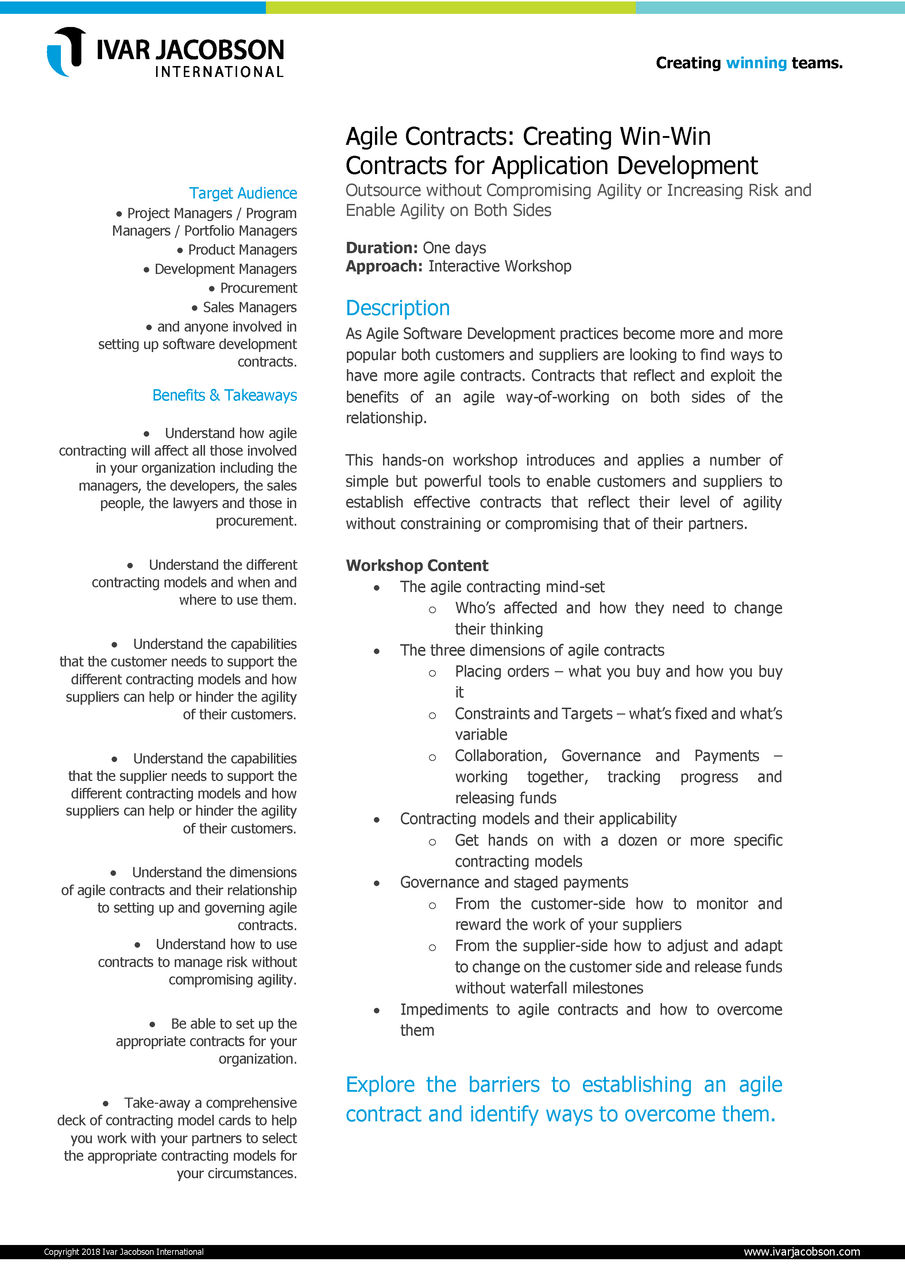
Learn About Agile Contracts with IJI

As Agile Software Development practices become more and more popular both customers and suppliers are looking to find ways to have more agile contracts. Contracts that reflect and exploit the benefits of an agile way-of-working on both sides of the relationship. This hands-on workshop introduces and applies a number of simple but powerful tools to enable customers and suppliers to establish effective contracts that reflect their level of agility without constraining or compromising that of their partners.

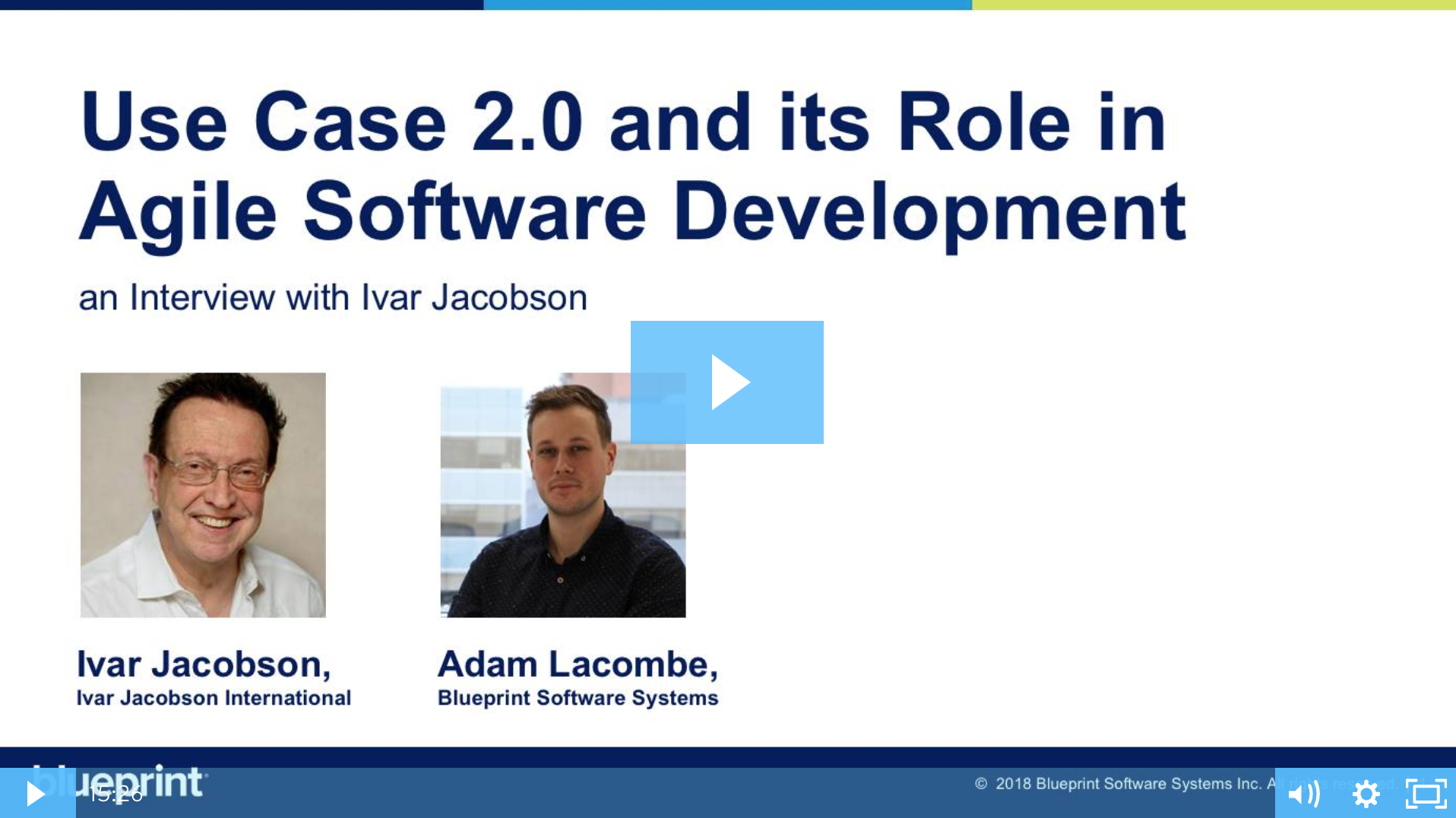
Use Case 2.0 and Agile Software development - Ivar Jacobson

Use-Case adoption is growing again: In this interview 'Use Cases and its role in Agile Software Development' by Blueprint Systems, Dr. Ivar Jacobson explains how Use-Case 2.0 includes everything important about user stories, but offer significantly more for larger systems, larger teams, and more complex and demanding development projects than user stories alone. They are as lightweight as user stories but can also scale in a smooth and structured way to incorporate as much detail as needed. Most importantly, they drive and connect many other aspects of software development.

Use Case 2.0 and Agile Software development - Ivar Jacobson

Adam Lacombe from BluePrint sat down with Ivar Jacobson, the father of component architecture, aspect-oriented software development, UML, RUP, and a multitude of other principles that have shaped the current software development landscape, to discuss his book Use-Case 2.0 and the role of use cases in Agile development practices. Use cases, as argued by Jacobson, “include the techniques that are provided by user stories, but offer significantly more for larger systems, larger teams, and more complex and demanding development projects than user stories alone. They are as lightweight as user stories but can also scale in a smooth and structured way to incorporate as much detail as needed. Most importantly, they drive and connect many other aspects of software development.”

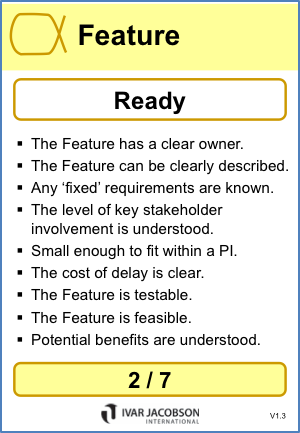
Free Agile Resources - Feature State Cards from Essence Agility Pack

Many teams struggle to let go of their waterfall, silo mentality when they first transition to agile ways-of-working. In particular they shy away from collaboratively working on the definition, evolution and implementation of their backlog items insisting on up-front definition of Features and Stories, and clean handovers between the Product Owners and the Development Teams. This is an issue that we see with all the various agile methods but which always seems to get compounded whenever teams try to scale. So what are the worst things you can do to compromise the agility of your program when using Features? In Part 3 of this series, Ian Spence provides guidance on what it means for a Feature to be Ready.

Agile at Scale Essentials Cards and Games for Software Teams

A modularized set of interchangeable practices that enable organizations to scale agile smoothly as part of a tailored transformation program that delivers value early and often, and builds a flexible and long-lasting library of practices, able to flex and grow over time in response to changing technology and business challenges.

Agile Essentials Cards and Games for Software Teams

The Agile Essentials practices provide a basic starter kit toolbox that covers all the common and critical aspects of team-based development. Each practice contains a small number of cards that provide useful, structured advice on how to successfully adopt and apply each practice.

SAFe PI Planning image

In this short blog Ian Spence looks at how many Features a SAFe® Agile Release Train needs to prepare to be ready for their PI (Program Increment) / big room planning event.