Agile Development

New Agile Standard Essence - a market disrupting innovation presentation

A new, cutting-edge approach can help you harness the principles of disparate software methodologies to accelerate adoption and deliver value. Essence, a modular standard created by the Object Management Group and promulgated by SEMAT (Software Engineering Method and Theory), provides a method-agnostic, common language for re-using software practices. Companies using Essence have seen dramatic cost-savings, process improvements and even new business creation.  Essence enables configuration of the 17 best-known agile methodologies in the market into smaller, foundational atomic “bricks” of re-usable practices. Currently the CA Technologies stack (CA PPM, Agile Central, CDM, Release Automation and Service Virtualization) is one of the unique environments that support all of these re-usable bricks of Agile practices.

Software development magazine ACMQUEUE logo

Essence  Agility is instrumental in moving software development toward a true engineering discipline.

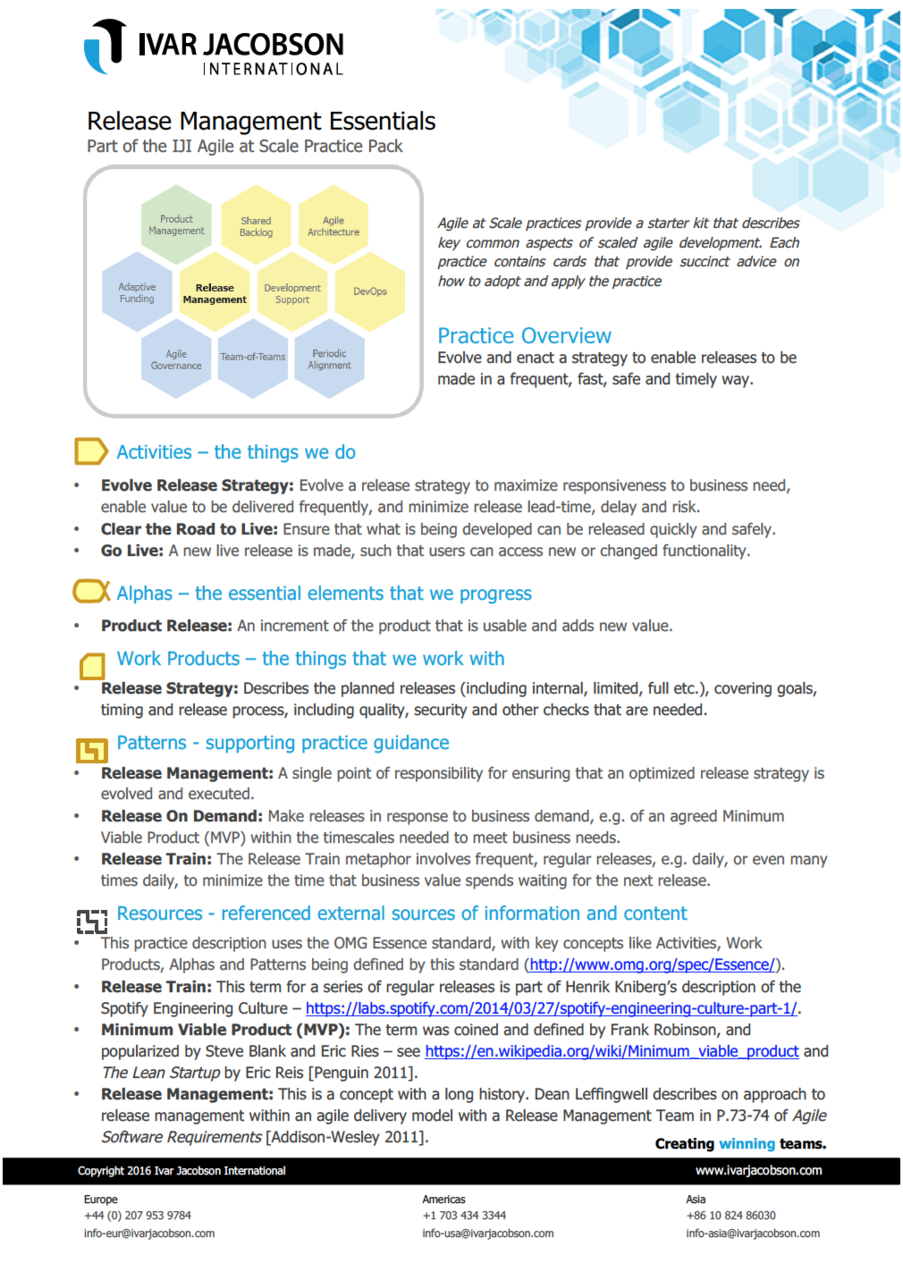
Learn about Agile Release Management Practices - Agile Coaching Tools from Essence Agility

Agile at Scale practices provide a starter kit that describes key common aspects of scaled agile development. Each practice contains cards that provide succinct advice on how to adopt and apply the practice. The Release Management Essentials Practice helps evolve and enact a strategy to enable releases to be made in a frequent, fast, safe and timely way. The practices helps: Evolve a release strategy to maximize responsiveness to business need, enable value to be delivered frequently, and minimize release lead-­time, delay and risk Clear the Road to Live ensuring that what is...

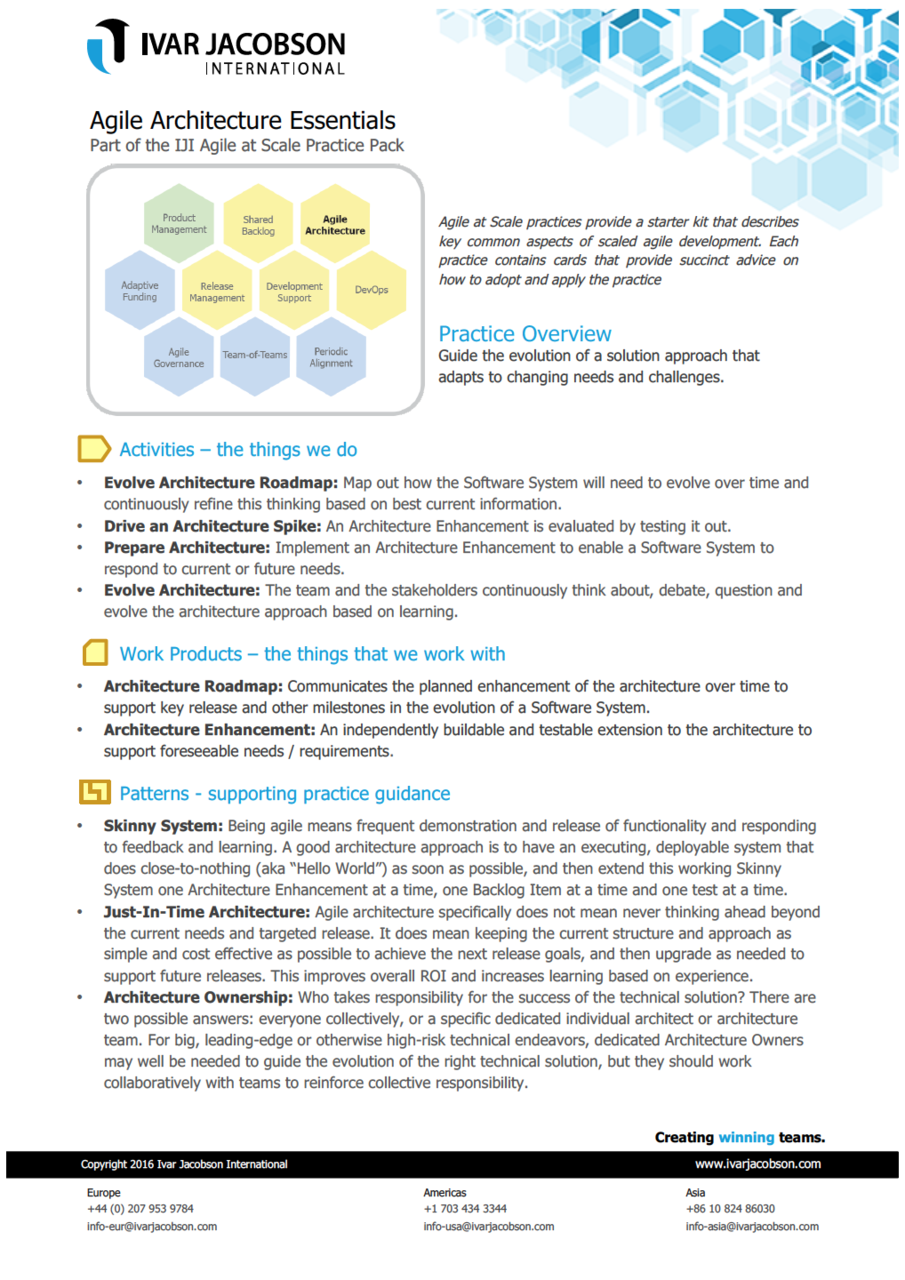
Agile Architecture Essentials Flyer - Improve your software engineering

The Agile Architecture Essentials practice provides guidance for achieving just-in-time architecture preparation and continuous and emergent evolution of the software system.

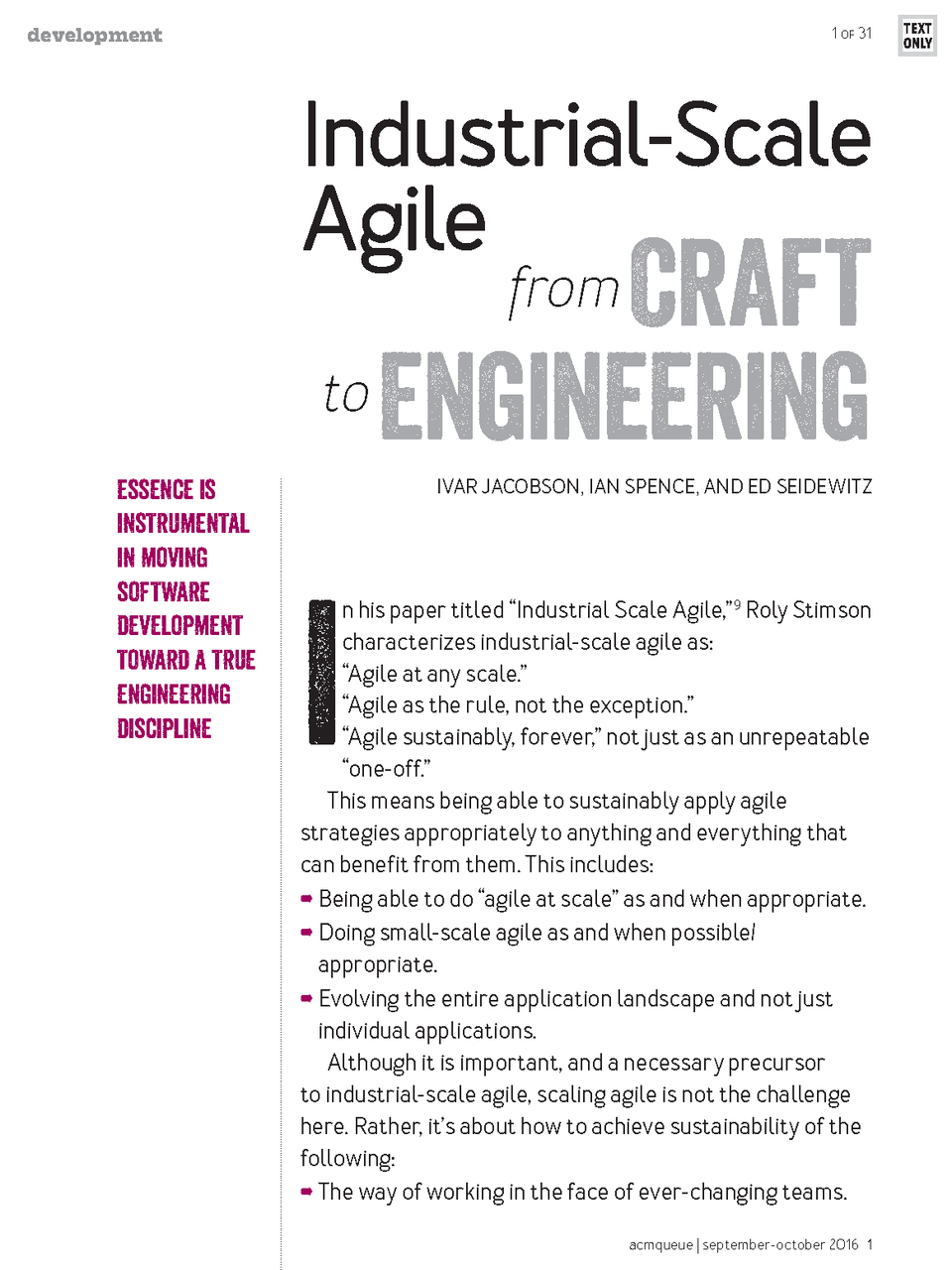
Industrial Scale Agile White Paper - Essence Agility

Industrial-­scale agile requires much more than just being able to scale agile. It also means taking a disciplined approach to ensuring that our IT investments are resulting in sustainable benefits for both the producing organization and its customers. This involves adopting a different approach to many aspects of agility. We need to look beyond small-­scale agile, beyond independent competitive islands of agile excellence, beyond individual craftsmanship and heroic teams, and beyond the short-­term, instant gratification that seems to be the focus of many well-­intentioned but self-­centered agile teams. It is this adoption of a more holistic approach that we call moving from craft to engineering. This paper is published at acm.org.

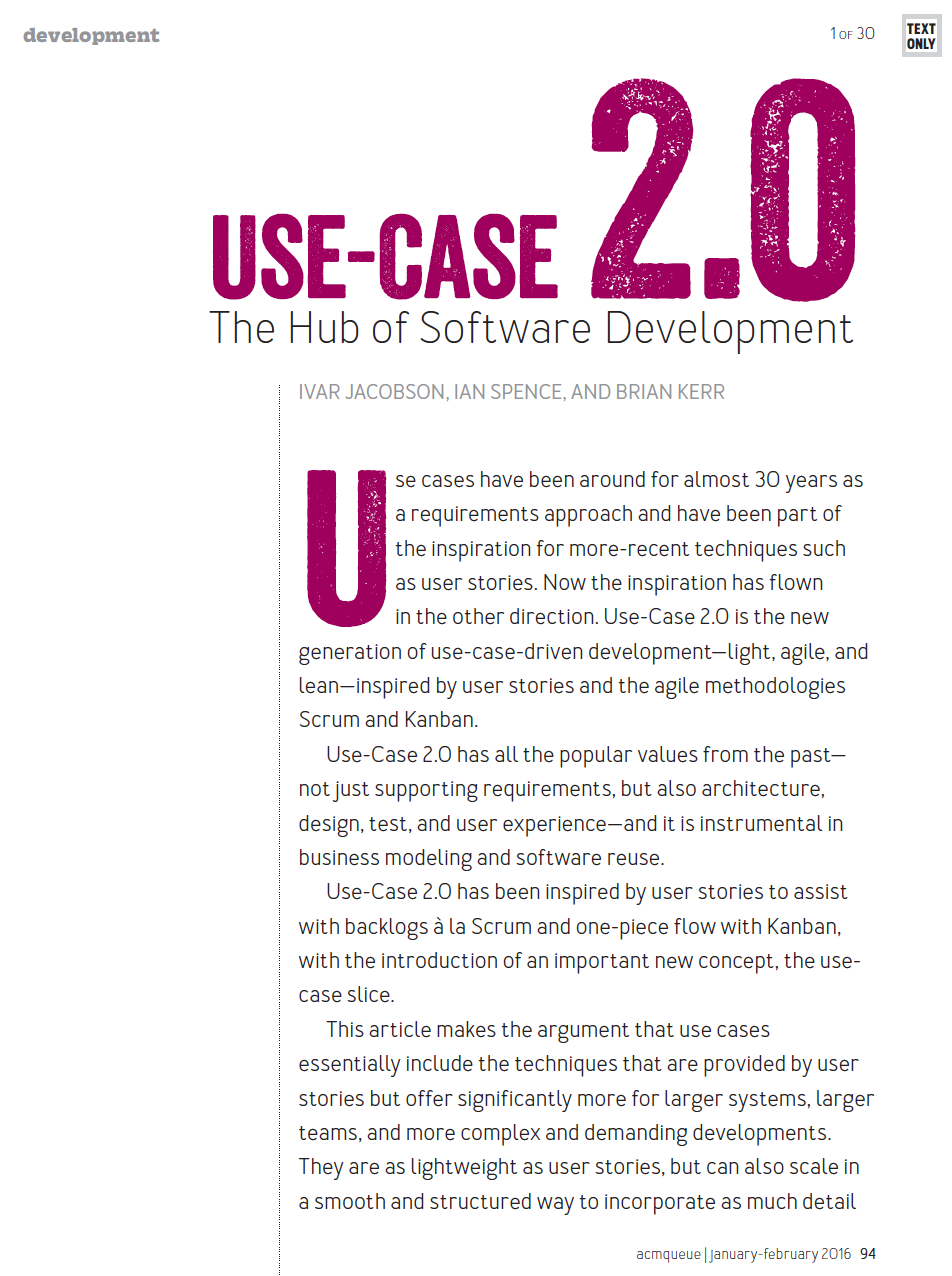
Use-Case 2.0 The Hub of Software Development Article image

Use cases have been around for almost 30 years as a requirements approach and have been part of the inspiration for more-recent techniques such as user stories. Now the inspiration has flown in the other direction. Use-Case 2.0 is the new generation of use-case-driven development—light, agile, and lean—inspired by user stories and the agile methodologies Scrum and Kanban. Use-Case 2.0 has all the popular values from the past—not just supporting requirements, but also architecture, design, test, and user experience—and it is instrumental in business modeling and software reuse.

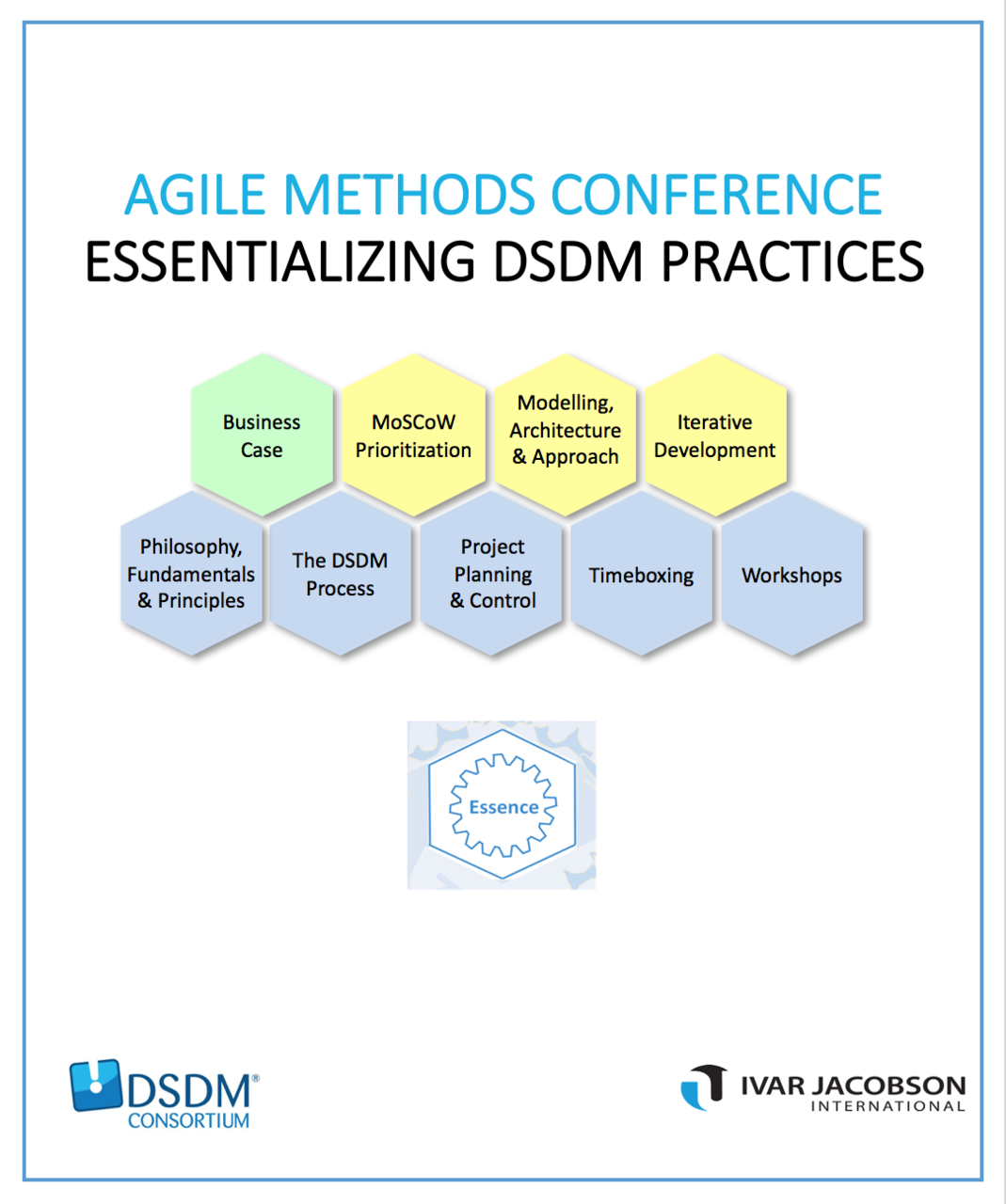
Essentializing DSDM Agile Projects paper, available to download

The challenges for many organizations when adopting DSDM (Dynamic System Development Method) are around mind set change, awareness and communication. The Essence standard helps teams navigate through many of the complex challenges common in software development delivery from helping teams identify and engage with the right stakeholders at the right time in the right way, to making health and progress visible to all in a language that everyone can understand. The Essence standard is presented in a number of tools such as a deck of Alpha State Cards, which are a simple, easy way to track status of a software project and help plan next steps. Applying Alpha State Cards with the DSDM Framework helps portray the aforementioned and enable communication between team members.

5 Tenets of Fostering Sustainable Change blog Post

Change. This simple word has been used to create communities, build businesses, and promote adoption within a myriad of other actionable objectives. It is as common as the air we breathe and as revolutionary as any invention. Yet in all of its grandeur, it has incessantly stumped many businesses and individuals along the way. Software has taken a front seat in several organizations. It has become the core to any business, and change initiatives have sprouted and evolved to provide better solutions, be they faster, smarter or more affordable. Furthermore, for those organizations that adapt to change well and continue to sustain said changes and evolve over time, the rewards are exponential and in many cases, lasting. As new companies emerge in markets offering innovative solutions that can ultimately disrupt the market, those organization that cannot and or will not adapt and change, and perhaps more importantly, sustain change will lose. As a result, software development teams are adopting agile development techniques to shorten development times, decrease risk, all whilst developing solutions to become more responsive to the needs of the business.

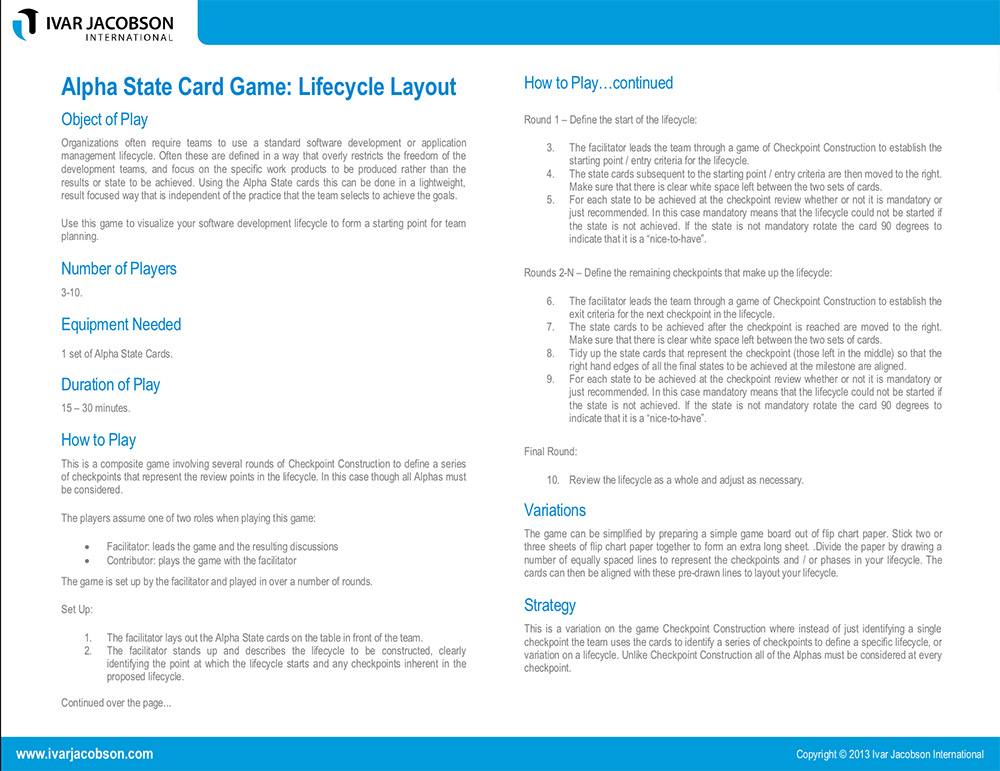
Agile Games - Lifecycle Layout Game - part of the Essence Agility Toolset for Agile professionals

Organizations often require teams to use a standard software development or application management lifecycle. Often these are defined in a way that overly restricts the freedom of the development teams, and focus on the specific work products to be produced rather than the results or state to be achieved. Using the Alpha State cards this can be done in a lightweight, result focused way that is independent of the practice that the team selects to achieve the goals. Use this game to visualize your software development lifecycle to form a starting point for team planning. Download...

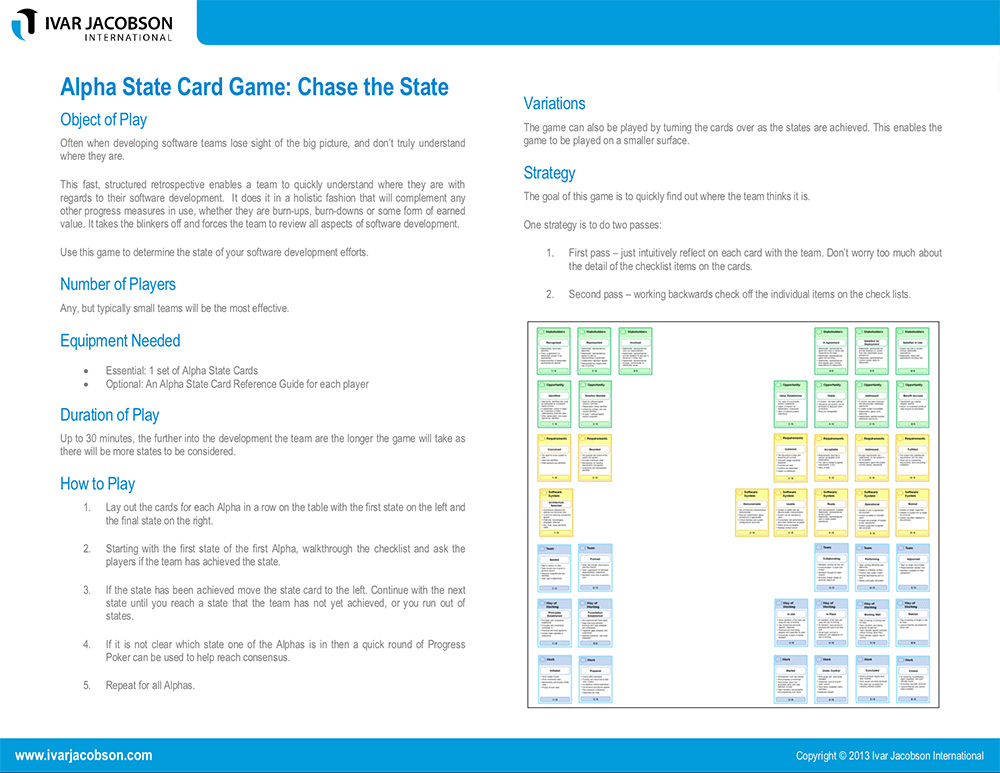
Chase the State Alpha Card Game from Essence Agility Toolset

Often when developing software teams lose sight of the big picture, and don’t truly understand where they are. This fast, structured retrospective enables a team to quickly understand where they are with regards to their software development. It does it in a holistic fashion that will complement any other progress measures in use, whether they are burn-ups, burn-downs or some form of earned value. It takes the blinkers off and forces the team to review all aspects of software development. Use this game to determine the state of your software development efforts. [Download the...